

Ideas que quiero que crezcan en este jardín.
Hey... it's okay. I also got Cs. I know where you're coming from. And I want you to know right here that you are not average.
I just don't want you to someday get grown-up Cs. Grown-up Cs means that maybe you're in a relationship with someone who's unkind. Grown-up Cs means you maybe don't have friendships that share laughter and those light-hearted moments that take the edge off of all of life. Grown-up Cs means you're often sad a lot, because you haven't discovered and then found a way to share what's wonderful about you. I want you to get grown-up As, man, because I love you. And that just means you're happy and peaceful. And that would make you way above average, man. Let's get there together. I will help you all of the time. Love... Floyd.
For about 10 years, I worked full time in prisons as a teacher, logging more than 40 hours a week behind those fences, including a long winter at one facility that had been a cereal factory and stood near the highway in downtown Indianapolis. It was a rock of a building with finger-thick grilles on the windows.
During my first week there, an inmate laughed when I asked him to reset the wall clock.
“A few minutes off?” he said. “We need one that goes by months and years. What do we care about five minutes?”
I mention this only because his words summed up the love story that had defined my life. When my wife left me, I was living in Paris, which was not as romantic as it may sound because I was incredibly lonely. My bones ached, especially at the sound of accordions in train stations.
All my plans had come to nothing. I had failed at marriage, failed at work and had no money to speak of. Sometimes I would see my ex-wife on the street and she would turn away with an eagerness that could not be ignored.
One night I came upon two boys robbing an old Vietnamese man, and when I tried to intervene and make them stop, they turned on me. I began to wonder if maybe a part of me wanted to die.
I moved back to the United States and took the job in the prison. I met the inmate who helped me with the clock. I also met an inmate who had salt-and-pepper hair, huge biceps and a pair of ridiculous glasses no one in the free world would ever wear. This inmate’s name was Mike.
Mike showed me a folder of clippings and photocopied certificates from all the educational programs he had completed in prison. He had earned a G.E.D. and a bachelor’s degree, as well as certifications in the usual programs like small engine repair and barbering.
He had kept letters from his counselors, chaplains and teachers. In these letters, supervisor after supervisor claimed to love him, but it all struck me as kind of sad and awkward. I couldn’t read the whole thing.
I had my own problems. I had taken a tiny apartment and spent my evenings trying to write a book and corresponding with women I had met on the Internet. I took all my lost chances personally.
When I first met Mike, he said: “These young guys — they just got locked up and they’ve got five years to do and they hate it. I get that. When you’re 20, five years is a long time, so they act out. I used to be like that. But now I’m two-thirds done, so every day is taking me closer to the door. When I think like that, I can get up in the morning and smile.”
A month later, my supervisor told me Mike had been locked up for more than 16 years and had at least 8 more to go. Arrested when he was a teenager, he wasn’t going to be released until he was in his mid-40s. He had raped the sheriff’s daughter in his hometown. It didn’t matter how fat his folder of supportive letters got.
“I used to be angry,” Mike told me. “I’d pick fights over nothing. I was mad to be in prison and I wanted everyone else to be mad, too. But then I realized: Man, this is my life. Do I want to be that guy? Always mad? I’m not going to get married or have a family. Not today. Maybe never. I’m going to be here. I’m a prisoner. There are some things I’m never going to do. And I can spend my life being mad about that, or I can try something else.”
I asked him what he had decided.
“I decided to be the best prisoner I could be,” he said.
This all relates to the clock on the wall because I fell in love again, and this became my new life. She was from New Hampshire and had never been to France. She left me for two years to write a memoir about her mother, but then she came back. She wrote me letters and I felt I knew her entire apartment because I studied the tiny photos she sent me of her sitting at her desk or standing by her curtains.
We were married, but not before I went to New Hampshire and met her mother. That afternoon, her mother could barely look at me. She was 48 and very sick, just a few months away from being dead.
My wife drove me through her hometown and I saw the lake where she had spent her summers when she was a teenager, not quite 5 feet tall and voluptuous in swimsuits long gone. We ate ice cream and talked quietly in the afternoon. She held my hand. She gave me an expensive watch that I kept wearing even after the crystal was scratched.
Our son is from Ethiopia, where I once saw a dead horse on the side of the road that resembled an abandoned sofa. I asked a friend if we needed to do something about that, and he said the wild dogs would take care of it.
We took our son far away from all of that five years ago, which may seem like a kindness, except it also hurts. I wish our son could know those dirt roads and the way they looked like chocolate milk in the rain, the way the hillsides were a delicate green, the way our driver would not go into the zoo because he was disgusted by the concrete ugliness of the lion cages.
I wish my son’s birth parents could see him swimming. He’s such a good swimmer. I wish they could hear him reading books aloud. I wish he could know them. I wish our son could speak Oromo, the language of his birth. Our story, so full of love, is also full of loss.
When I was younger, I used to get up early in the morning to write. Now I get up early to make my son breakfast. I rarely stay up late. I like my job, but I have to work after dinner most nights. I can reach my laptop only if I lean over the pile of markers and a tiny Buzz Lightyear on my desk. My wife hasn’t worn a bikini for six years and probably never will again; she says she’s too old, which makes me sad.
She is a beautiful woman with gray in her hair. My parents no longer drive at night and have fewer and fewer hobbies. This summer my mother made a box of cookies just for my son, and I was happy to see them talking quietly in the kitchen.
I’m constantly aware of lost opportunities. I used to think such lost opportunities were beautiful towns flashing by my train windows, but now I imagine they are lanterns from the past, casting light on what’s ahead.
My life is constrained in hundreds of ways and will be for years as my son grows up and my wife and I grow older. I don’t know when I will return to Paris, if ever. I don’t know when or if I will finish my book.
I do know I love eating breakfast with my son. My wife wants us to open only one box of cereal at a time to keep the flakes from going stale, but my son and I get up first, so we eat what we want. We like to change. He gives me a thumbs-up whenever I open a new box.
In our family, we talk about our days and recount our “best part” and “worst part” at dinnertime. Last week, I was reading a bedtime story with my son and was distracted by the laptop and work waiting on my desk, but I turned to him and said, “We forgot ‘best part, worst part.’ What was the best part of your day?”
He pushed his chin into my shoulder and said: “This is, Daddy. This is.”
I felt a complete fool. I had to close my eyes for a moment. And then we agreed that his worst part was when he had cried about eating chickpeas.
When I was a boy, I hated beets. I hope I can protect my son from beets until he’s old enough to hold in the tears. They’re not worth it.
When the battery in my watch died, I still wore it. There was something about the watch that said: It doesn’t matter what time it is. Think in months. Years.
Someone loves you. Where are you going? There are some things you will never do. It doesn’t matter. There is no rush. Be the best prisoner you can be.
—Chris Huntington
Kierkegaard, mi existencialista favorito, tiene la mejor definición: la ansiedad es el vértigo de la libertad. Imagínate que estás al borde de un acantilado, asomándote a un precipio. No tienes miedo a caerte, tienes miedo A QUE TÚ TE TIRES. Te das cuenta de cuánta libertad tienes, que podrías quitarte en la vida en cualquier momento (!!!!). Esa libertad de acción es la que genera la ansiedad; cuando hay libertad de acción y no hacemos nada, cocinamos la receta para la depresión, porque entramos en parálisis por análisis. Y es que según Kierkegaard en La enfermedad mortal (1849) hay dos formas de enfrentar esta ansiedad o vértigo de libertad:
Perderse en el infinito. Soy libre, puedo hacer lo que quiera, así que voy a ver a qué me quiero dedicar. Cuántas opciones y posibilidades...voy a hacer una lista. Voy a preguntar la opinión de mis amigas. No sé que hacer, así que seguiré pensando hasta que se me occura. Esta persona muere antes de tomar una decisión y pasa su vida en parálisis por análisis (yo literal fr fr).
Perderse en lo finito. No sé qué me gusta ni si me gusta algo, pero mi amiga ha hecho un curso de crochet. Voy a hacer lo mismo. Mucha gente en TikTok habla bien de esta carrera, voy a estudiarla. No quiero hacer nada, voy a hacer lo que surja y ya está. Esta persona no puede sostener el peso de su libertad, así que se copia, por lo que muere imitando, escondiéndose y no creando.
Esta es la dialéctica entre lo infinito y lo infinito como una de las formas de la desesperación. Pero en lugar de ello, podemos decidir crear nuestra realidad. Intentarlo, fracasar, ganar, vivir. No tenemos nada que perder, chicas.
Yasmina Stitou
[Eurylochus] (V.O.) What was the Sirens’ song?
[Odysseus] (V.O.) All the things you’d want it to be. Then all things you wish you never wished for… It was the delicious itch you go to scratch… But find it’s under the skin, and can’t be reached… So the delicious itch becomes unbearable… It told you what you most want is what you most can’t have, and what you most can’t have is what you already had and lost… It was the song of all the promises I’ve failed to keep…
[Odysseus] And it told me I don’t really want to go home.
The technical term used by the researchers is mythemes: units of narrative whose meaning emerges through their relationships with other elements. The book’s landmarks are not only locations. They also include ways of paying attention.
Forest. Water. Farm. See. Ask. Listen. Understand.
Of course, every map is partial. A knowledge atlas does not offer the territory itself. It offers an interpretation of it. But that limitation is not a reason to avoid maps. It’s a reason to teach learners to examine them, to suspect their soundness, as Schumacher said. What has been made central? What remains at the edge? Which routes are encouraged? Which ones are impossible to take? Who drew the map and what did they believe the territory was for?
The most powerful learning formats may not give learners a finished map. They might help learners navigate one map, question it, and eventually redraw parts of it for themselves...
Stefy Bolaños
She knows the rules. She just doesn’t always feel like following them.
When she escapes for a little run, or simply because she feels like doing her own thing, we have to go and collect her. And secretly, we love her even more for itWe love her for her stubborn, cheeky character. When she’s about to escape from the garden, she gives you a look that makes it very clear she knows exactly what she’s doing, and exactly what she’s supposed to be doing instead.
When I try to put her in place and say “Shaia, no! Stay here!” She looks up at me with those puppy eyes, rolls onto her back and puts her paws in the air: “Okay okay, I give up”
Jule Noah
El “tiro por la culata” (¿será demasiado argentina esa expresión?) de todo esto, es que por oposición muchos de nosotros estamos volviendo (o nunca dejamos de hacerlo) a escribir cartas, encontrarnos en persona, leer libros enteros, a ver la belleza en el error, a apoyar a otros artistas, etc. En fin, usar las redes como una caballo de Troya, sabiendo que lo que importa es cuidar nuestra imaginación como uno de nuestros mayores tesoros.
Ayelén Linardi
no dejes
que las lámparas
artificiales hagan sombras raras
no sueñes
si querés
que tus sueños
se hagan realidad
ya sabías cantar
antes de que emitieran tu partida
de nacimiento
apagá de una vez
el equipo de música
que te dio este país
funciona pésimo
tu tierra prometida
es tu respiración
si tenés ganas
de sentirte un magnate
prestales atención
a tus manos
que por definición la magia
empieza ahí
—Pedro Pietri
i
Make a place to sit down.
Sit down. Be quiet.
You must depend upon
affection, reading, knowledge,
skill—more of each
than you have—inspiration,
work, growing older, patience,
for patience joins time
to eternity. Any readers
who like your poems,
doubt their judgment.
ii
Breathe with unconditional breath
the unconditioned air.
Shun electric wire.
Communicate slowly. Live
a three-dimensioned life;
stay away from screens.
Stay away from anything
that obscures the place it is in.
There are no unsacred places;
there are only sacred places
and desecrated places.
iii
Accept what comes from silence.
Make the best you can of it.
Of the little words that come
out of the silence, like prayers
prayed back to the one who prays,
make a poem that does not disturb
the silence from which it came.
—Wendell Berry
—Marison Cerrini Madrid
Así que autenticidad, poca. Pero, sin embargo, desde el punto de vista de las consumidoras voraces que somos, seguimos valorando más a quienes percibimos como auténticos, que por su lado lo único que están haciendo es conseguir que su construcción nos resulte más congruente, menos forzada, más alineada con las múltiples señales que recibimos de ellos. Queriendo, o sin querer, escrutinizamos a cualquiera y somos rápidas para descartarlo si hace o dice algo distinto a lo que nos gustaría recibir. Entonces nos sentimos como decepcionadas y ale, nos desuscribimos o le damos al unfollow.
Deborah Marín
Fracasar y a veces encontrar algo que funciona, algo consecuente y quizás hasta bello, algo que antes no estaba allí; va sobre transmitir conexiones que importan, sobre contar historias con manos sobre manos [...] sobre elaborar condiciones para el florecer finito en la tierra.
Donna Haraway
cuando te veo
toda tapada como la basura
sentada ahí, cercada del olor
de cáscara de papas demasiado añejas
o
cuando te veo
con los zapatos de tu papá
con el dedito afuera
sentada ahí, esperando tu cordura
como las compras de la semana que viene
digo
cuando te veo
mujer hecha una bolsa humedecida de papel
que eras la chica más linda de georgia
que te decían la Rosa de Georgia
yo me pongo de pie
frente a tu destrucción
yo me pongo de pie
—Lucile Clifton
Voy a decirle que la espero desde hace mucho.
Desde hace más tiempo que el que llevo vivo. Que la espero desde mis vidas pasadas, cuando fui un caballero valeroso y un hombre de las cavernas. Voy a decirle que me parece un cactus magnifico. Voz a decirle que sé que mi aspecto es cero viril, pero que este verano ha aprendido que el valor no tiene nada que ver con la virilidad, sino con el peligro, y que absolutamente nada es más peligroso que plantarse delante de un cactus magnífico para hacerle una declaración de amor, salvo tal vez la guerra y las eliminatorias de hockey.
Voy a decirle que estar en peligro delante de ella es lo más maravilloso del mundo y voy a decirle que si me echo a llorar espero que entienda que son lágrimas de valor y que apuesto a que si las guardásemos en un tarro junto con las lágrimas de mi padre y las de mi hermano y las de los policías de paisano después de una buena redada, el tarro se desbordaría y las lágrimas se derramarían por el suelo, se colarían por las grietas del hormigón, por las acequias y bajo la tierra, y al día siguiente crecería una flor, ni espectacular ni exótica, un sencillo diente de león, pero verdadera, y yo se la regalaría y le diría: «Ésta es la flor del valor, te la regalo, te quiero»
Louis entre fantasmas
—Vos sabés —dijo mirando hacia el escenario que había quedado vacío—, el artista viene al mundo con un carcaj que contiene un número limitado de flechas doradas.
Parecía hablarle a un fantasma que estaba ahí y que yo no veía.
—Puede lanzar todas sus flechas de joven, o lanzarlas de adulto, o incluso ya de viejo.
Hizo una pausa dramática como en el teatro y prendió su porro. Aspiró
como si tragara una bocanada de aire fresco.
—También puede ir lanzándolas de a poco, espaciadas a lo largo de los años. Eso sería lo ideal, pero ya sabés que lo ideal es enemigo de lo bueno.
Lo dijo como si estuviera improvisando, pero se notaba que era algo que tenía muy pensado.
—¿Quiere decir que el artista no tiene control sobre esas flechas? —le pregunté.
—No mucho —seguía hablándole al vacío, pero escuchaba. Pegó otra pitada—. It just happens. Y solo al final de una vida se puede evaluar la periodicidad de los lanzamientos.
María Gainza
Que nunca deje de ser traviesa,
que nunca deje de ser atrevida.
Que mis cenizas, cuando las tengas, amiga,
y las entregues al océano,
salten en la espuma de las olas,
amando aún el movimiento,
aún dispuestas, más allá de todo,
a danzar por el mundo.
—Mary Oliver
Volvía a descubrir en Tipasa que había que guardar intactas dentro de uno mismo una frescura, una fuente de alegría; amar el día que escapa a la injusticia y volver al combate con esa luz conquistada (...) Yo había sabido siempre que las ruinas de Tipasa eran más jóvenes que nuestras obras en construcción o nuestros escombros. El mundo empezaba allí cada día con una luz siempre nueva. ¡Oh, luz!, ése es el grito de todos los personajes enfrentados, en el drama antiguo, a su destino. Ese último recurso era también el nuestro y ahora yo lo sabía. En mitad del invierno aprendía por fin que había en mí un verano invencible.
Albert Camus
There I was, atop this massive mountain, holding a tiny fragment from the bottom of the world — a beautiful souvenir from the beginning of life, a bright reminder that time makes and remakes worlds.
Suddenly, against this immense backdrop of the majesty and mystery of the universe, I was no longer in the wound — I was in wonder. It is the self that suffers by the story that cinches the moment. Every act of unselfing — of contacting the interconnectedness of everything that ever was and ever will be, the wondrous totality held in time — is a salve for suffering, a way of being reborn.
As to my daily practice of learning to trust time, somewhere along the way of making these serpentine birdworlds, I crossed the threshold between wound and wonder, and my heart began healing. We don’t choose our wounds. But we can choose to let go of the story and wing ourselves with wonder. It is what makes this rocky planet a world and this existence a life.
Maria Popova
¿Por qué es vulnerable justamente la credibilidad? Porque la universidad evalúa, y por tanto acredita, a través de evidencias de aprendizaje que descansan, simplificando, en dos grandes tipos de mecanismos. Debemos aclarar que nos referimos aquí específicamente a la evaluación sumativa (la orientada a reconocer y acreditar el aprendizaje), no a la evaluación formativa (la que permite el acompañamiento al estudiante en su proceso). La evaluación formativa es la gran olvidada por el sistema universitario (a pesar de ser la palanca más potente para mejorar el desempeño de los estudiantes). Tanto es así que habitualmente el término “evaluación” se hace sinónimo de “evaluación sumativa” tomando la parte por el todo.
La respuesta instintiva y de corto plazo, cuando ha sucedido, ha sido una carrera de armamentos: me intentan hacer trampa, pongo una barrera; buscan otra trampa, pongo otra. Es una carrera agotadora y, a la larga, perdida. Existen ya alternativas pedagógicas, metodológicas y tecnológicas para rediseñar la evaluación y recomponer el vínculo entre evidencia y aprendizaje.
Sucede además que la irrupción de la IA se ha percibido como un reto tecnológico, y cada una de las tres crisis se está tratando como un problema a resolver con un enfoque prioritariamente tecnológico. Pero no es (solo, ni principalmente) un reto tecnológico; es más bien un reto existencial y pedagógico atravesado por la tecnología. La consecuencia de ese sesgo de diagnóstico es que, en una primera ola, el encargo ha recaído en muchas ocasiones en los responsables de tecnología de las universidades, cuyo trabajo consiste, en la práctica y en la mayor parte de los casos, en decidir con qué proveedor se trabaja y comprar soluciones. Y esas decisiones de compra se toman desde hace años con una lógica defensiva y conservadora, que equipa a las universidades, y a sus profesores, con las herramientas más probadas (las menos innovadoras), las que generan menos problemas de gestión, menores riesgos y más garantías de seguridad — las que, por tanto, cambian poco las reglas del juego. Desde la perspectiva de los profesores (y evaluadores): cajas negras que limitan su agencia y su capacidad de responder diseñando alternativas que sean a la vez valiosas en términos de aprendizaje y robustas en lo que se refiere a los mecanismos de evaluación sumativa.
Esto es así porque el título universitario (y, por extensión, las diferentes credenciales) funciona, en términos económicos, como una señal. Socialmente asumimos que solo quien ha aprendido puede lograr el título, con todas las discusiones que caben sobre qué significa haber aprendido, y el empleador, que en principio no puede observar directamente (o le supone un coste que prefiere no asumir) los conocimientos y habilidades de una persona, confía en que el título los resume. Esa asunción era segura mientras obtener el título costaba mucho más a quien no había aprendido que a quien sí. Es exactamente lo que la IA generativa puede estar rompiendo al desacoplar los entregables y las pruebas de evaluación del aprendizaje, dado que el coste de emitir la señal se hunde, y se hunde por igual para todos. Cuando la señal deja de informar, quien la recibe deja de fiarse de todas: el egresado que sí aprendió “paga” por los que no, y el valor del título, de todos los títulos, se degrada. Es la vieja lógica del mercado de los limones que describió Akerlof: cuando el comprador no puede distinguir la calidad, lo malo acaba expulsando a lo bueno.
Restaurar la credibilidad usando solo, o principalmente, más vigilancia, más control y más tecnología defensiva, sin tocar el significado y el método, sería ganar la batalla equivocada, y por poco tiempo. Sin embargo, puede que esta crisis, precisamente porque explota antes, sea la que obligue por fin a las universidades a enfrentarse a las otras dos preguntas, las importantes: qué hay que aprender hoy, y cómo.
Juan Freire
Yo misma he evadido el asunto cuando me lo han preguntado. Y contesto lo siguiente: la inspiración no es privilegio exclusivo de los poetas ni de los artistas en general. Hay, hubo, habrá siempre un número de personas en quienes de vez en cuando se despierta la inspiración. A este grupo pertenecen los que escogen su trabajo y lo cumplen con amor e imaginación. Hay médicos así, hay maestros, hay también jardineros y centenares de oficios más. Su trabajo puede ser una aventura sin fin, a condición de que sepan encontrar en él nuevos desafíos cada vez. Sin importar los esfuerzos y fracasos, su inquietud no desfallece. De cada problema resuelto surge un enjambre de nuevas preguntas. La inspiración, cualquier cosa que sea, nace de un perpetuo «no lo sé».
Si mi compatriota María Sklodowska-Curie no se hubiera dicho «no sé», probablemente se habría quedado como maestra de química en un colegio para señoritas de buena familia y en este trabajo, por otra parte muy decente, se le hubiera ido la vida. Pero siguió repitiéndose «no sé» y justo estas palabras la trajeron dos veces a Estocolmo, donde se otorgan los premios Nobel a personas de espíritu inquieto y en búsqueda constante.
El mundo, a pesar de cualquier cosa que podamos pensar sobre él, espantados por su inmensidad y nuestra impotencia ante él, amargados por su indiferencia frente a los sufrimientos particulares de la gente, de los animales y tal vez de las plantas -ya que ¿de dónde proviene la certeza de que las plantas están libres de sufrimientos?-; a pesar de cualquier cosa que pensemos sobre sus espacios atravesados por la radiación de las estrellas, alrededor de las cuales se empieza a descubrir algunos planetas -¿ya muertos?, ¿todavía muertos?, no se sabe-; a pesar de cualquier cosa que pensáramos sobre este teatro inmenso, para el cual tenemos un billete de entrada pero su vigencia es ridículamente corta, limitada por dos fechas decisivas; a pesar de no sé qué cosa más que pudiéramos pensar sobre este mundo: es asombroso.
De acuerdo, en el habla cotidiana, la cual no recapacita sobre cada palabra, usamos expresiones como «la vida común», «los acontecimientos comunes»… Sin embargo, en la lengua de la poesía, donde se pesa cada palabra, ya nada es común. Ninguna piedra y ninguna nube sobre esa piedra. Ningún día y ninguna noche que le suceda. Y sobre todo, ninguna existencia particular en este mundo.
Wislawa Szymborska
Una amiga me contó que la hizo estacionar diez veces seguidas en el mismo lugar hasta que dejó de pedirle perdón al auto de atrás. Otra me dijo que empezó su primera clase llorando en el asiento del acompañante, y Norma le dijo: “No hace falta que hables, solo poné primera y doblá en la próxima”.
Carolina Garber
I am a happy planet helplessly orbiting my wife, the sun; I am her vassal, her monkey on a chain, in her thrall, drunk on her, lost to her. I suspect if you asked her, she’d say she’s the planet, and I’m the sun, but that would be her being modest. Whatever the case, we are better together and a mess apart, fully entangled, all in, happily doomed. By the way, there was an eclipse last night, marking, amongst other things, twenty-seven years of our marriage. How thoughtful of the cosmos to have remembered.
Nick Cave
Haberse muerto tanto y que la boca
quiera vivir un poco todavía
y que el cuerpo, los brazos y la boca
y que las noches cálidas, los días
ciegos, y el frío sin sexo de la aurora…
Haberse muerto tanto y de tal modo
y sostener un nombre todavía
y una voz que se afirma y se alza en números.
Haberse muerto tanto y que las lilas,
y las tintas azules y las rojas
y las hojas, las rosas y las lilas…
—Idea Vilariño
A good deal of my life has been devoted to trying to demystify ways of thinking that polarize and oppose. Translated into politics, this means favoring what is pluralistic and secular. Like some Americans and many Europeans, I would far prefer to live in a multilateral world—a world not dominated by any one country (including my own). I could express my support, in a century that already promises to be another century of extremes, of horrors, for a whole panoply of meliorist principles—in particular, for what Virginia Woolf calls “the melancholy virtue of tolerance.”
Let me rather speak first of all as a writer, as a champion of the enterprise of literature, for therein lies the only authority I have.
The writer in me distrusts the good citizen, the “intellectual ambassador,” the human rights activist—those roles which are mentioned in the citation for this prize, much as I am committed to them. The writer is more skeptical, more self-doubting, than the person who tries to do (and to support) the right thing.
One task of literature is to formulate questions and construct counter-statements to the reigning pieties. And even when art is not oppositional, the arts gravitate toward contrariness. Literature is dialogue; responsiveness.
Literature might be described as the history of human responsiveness to what is alive and what is moribund as cultures evolve and interact with one another.
Writers can do something to combat these clichés of our separateness, our difference—for writers are makers, not just transmitters, of myths. Literature offers not only myths but counter-myths, just as life offers counter-experiences—experiences that confound what you thought you thought, or felt, or believed.
A writer, I think, is someone who pays attention to the world. That means trying to understand, take in, connect with, what wickedness human beings are capable of; and not be corrupted—made cynical, superficial—by this understanding.
Literature can tell us what the world is like.
Literature can give standards and pass on deep knowledge, incarnated in language, in narrative.
Literature can train, and exercise, our ability to weep for those who are not us or ours.
Who would we be if we could not sympathize with those who are not us or ours? Who would we be if we could not forget ourselves, at least some of the time? Who would we be if we could not learn? Forgive? Become something other than we are?
Susan Sontag
Prefiero el cine.
Prefiero los gatos.
Prefiero los robles a orillas del río.
Prefiero Dickens a Dostoievski.
Prefiero que me guste la gente a amar a la humanidad.
Prefiero tener en la mano hilo y aguja.
Prefiero no afirmar que la razón es la culpable de todo.
Prefiero las excepciones.
Prefiero salir antes.
Prefiero hablar de otra cosa con los médicos.
Prefiero las viejas ilustraciones a rayas.
Prefiero lo ridículo de escribir poemas a lo ridículo de no escribirlos.
En el amor, prefiero los aniversarios no exactos que se celebran todos los días.
Prefiero a los moralistas que no me prometen nada.
Prefiero la bondad astuta a la demasiado crédula.
Prefiero la tierra vestida de civil.
Prefiero los países conquistados a los conquistadores.
Prefiero tener reservas.
Prefiero el infierno del caos al infierno del orden.
Prefiero los cuentos de Grimm a las primeras planas del periódico.
Prefiero las hojas sin flores a la flor sin hojas.
Prefiero los perros con la cola sin cortar.
Prefiero los ojos claros porque los tengo oscuros.
Prefiero los cajones.
Prefiero muchas cosas que aquí no he mencionado a muchas otras que tampoco he dicho.
Prefiero el cero solo al que hace cola en una cifra.
Prefiero el tiempo de los insectos al tiempo de las estrellas.
Prefiero tocar madera.
Prefiero no preguntar cuánto me queda y cuándo.
Prefiero tomar en cuenta incluso la posibilidad de que todo tiene una razón de ser.
—Wislawa Szymborska
I can appreciate the beauty of a flower. At the same time, I see much more about the flower than he sees. I could imagine the cells in there, the complicated actions inside, which also have a beauty. I mean it’s not just beauty at this dimension, at one centimeter; there’s also beauty at smaller dimensions, the inner structure, also the processes. The fact that the colors in the flower evolved in order to attract insects to pollinate it is interesting; it means that insects can see the color. It adds a question: does this aesthetic sense also exist in the lower forms? Why is it aesthetic? All kinds of interesting questions which the science knowledge only adds to the excitement, the mystery and the awe of a flower. It only adds. I don’t understand how it subtracts.
Richard Feynman
That’s why you should give up on trying to reach a phase of life that’s problem-free. It’s also why you should stop trying to clear the decks and instead just get on with doing stuff that matters, while tolerating the fact that the decks aren’t clear. And it’s why you should treat your pile of unread books and articles as a river instead of as a bucket you might one day manage to empty.
Oliver Bukerman
Research is conventionally understood as occurring within academia—and potentially in government or corporate research labs, think tanks, and similar institutions. But the phrase “research as leisure activity” suggests, for me, a form of research that is explicitly not isolated to traditional institutions.
Research as leisure activity is directed by passions and instincts. It’s fundamentally very personal: What are you interested in now? It’s fine, and maybe even better, if the topic isn’t explicitly intellectual or academic in nature. And if one topic leads you to another topic that seems totally unrelated, that’s something to get excited about—not fearful of.
Who is doing this kind of research as leisure activity? Artists, often. To return to the site that originally inspired this post—I’d say that the artist/designer/educator Laurel Schwulst uses Are.na to develop and refine particular themes, directions, topics of inquiry…some of which become artworks or essays or classes that she teaches.
What’s also striking to me is that autodidacts often begin with some very tiny topic, and through researching that topic, they end up telescoping out into bigger-picture concerns. When research is your leisure activity, you’ll end up making connections between your existing interests and new ideas or topics. Everything gets pulled into the orbit of your intellectual curiosity. You can go deeper and deeper into a narrow topic, one that seems fascinatingly trivial and end up learning about the big topics: gender, culture, economics, nationalism, colonialism.
Celine Nguyen
It's not a mystery that I'm a fan of asynchronicity when it comes to online interactions. In a world where it is imperative to react and be first, the concept of doing things slowly at your own time and pace is refreshing. And it's even better when conversations are conducted this way through blog posts on personal sites.
Manu Moreale
The Garden is the web as topology. The web as space. It’s the integrative web, the iterative web, the web as an arrangement and rearrangement of things to one another.
Mike Caufield
Digital gardens explore a wide variety of topics and are frequently adjusted and changed to show growth and learning, particularly among people with niche interests. Through them, people are creating an internet that is less about connections and feedback, and more about quiet spaces they can call their own.
Tasked with abating any breaches to the secrecy of the operation, they cautioned Feynman that coded messages were against the rules and demanded that his wife include a key in each letter to help them decipher it. This only amplified Arline’s sense of fun — she began cutting holes into her letters, covering passages with ink, and even mail-ordered a jigsaw puzzle kit with which to cut up the pages and completely confound the agents.
Maria Popova
There is a faith in loving fiercely
the one who is rightfully yours,
especially if you have
waited years and especially
if part of you never believed
you could deserve this
loved and beckoning hand
held out to you this way.
I am thinking of faith now
and the testaments of loneliness
and what we feel we are
worthy of in this world.
Years ago in the Hebrides,
I remember an old man
who walked every morning
on the grey stones
to the shore of baying seals,
who would press his hat
to his chest in the blustering
salt wind and say his prayer
to the turbulent Jesus
hidden in the water,
and I think of the story
of the storm and everyone
waking and seeing
the distant
yet familiar figure
far across the water
calling to them
and how we are all
preparing for that
abrupt waking,
and that calling,
and that moment
we have to say yes,
except it will
not come so grandly
so Biblically
but more subtly
and intimately in the face
of the one you know
you have to love
so that when
we finally step out of the boat
toward them, we find
everything holds
us, and everything confirms
our courage, and if you wanted
to drown you could,
but you don’t
because finally
after all this struggle
and all these years
you simply don’t want to
any more
you’ve simply had enough
of drowning
and you want to live and you
want to love and you will
walk across any territory
and any darkness
however fluid and however
dangerous to take the
one hand you know
belongs in yours.
—David Whyte
Todo esto es mi forma de decir que cada vez que tengo amor por un lugar también tengo razones para no querer irme y es también mi forma de decir que me da miedo no tener raíces en ningún lugar, pero sé que en el fondo llevo todo lo que importa dentro de mí y hay cosas que nunca podré perder porque soy y siempre seré un archivo de todo aquello que he amado.
Rosalía
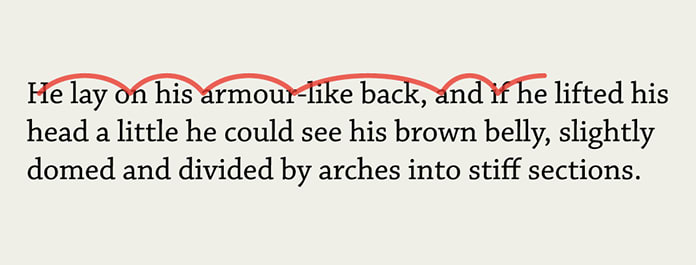
The shapes of letters and the shapes they make when combined into words and sentences can significantly affect our ability to decipher text. If we look at an average line of text and cover the top halves of the letters, it becomes very difficult to read.
Jason Santa Maria
For Frere-Jones, letting a project marinate untouched for a while is a deliberate part of his design process. “You’ll always see something that you didn’t see before, sometimes because you’d been looking at it for so long that you became kind of numb,” he says, “or you made an initial decision based on something that was no longer relevant, or you revised your criteria over time. Matthew Carter remarked once that he never regretted putting something in a drawer and coming back to it later. There would always be a way to benefit from a refreshed perspective.”
Tobias Frere-Jones
The biggest mistake, I think, was from the fountain pen makers who tried to make a fountain pen as cheap as the ballpoint. They lost the character of the pen.
But Kaweco can do it because the product is like leather. When you have leather and you use it, you get scratches. In the end, it’s yours. It’s your style. This is what we wanted with our pens as well.
Choosing Keeping
The Reflective Practitioner was written in the early 1980s and took as its premise that the world of work was changing rapidly, that there was a group of people (Richard Florida’s Creative Class mostly) who, unlike doctors, engineers, and scientists, didn’t rely on technical knowledge for their expertise. Schön calls these people “practitioners” and their ranks include everything from social workers to city planners to architects and designers. People who, in the words of Charles Reich, “can be counted on to do their job, but not necessarily to define it.”
Being a practitioner means that the traditional methods and techniques of analytical thinking and scientific process simply don’t work. Problems in the messy world of practitioners “are interconnected, environments are turbulent, and the future is indeterminate.” What is called for under these conditions, Schön argues, are professionals who can, as Russell Ackoff says, “design a desirable future and invent ways of bringing it about.”
The everyday life of practitioners involves “tacit knowing-in-action,” that is, we instinctively know stuff and know how to do stuff, even if we can’t explain how to do it.
When confronted by an unusual situation, practitioners “seek to discover the particular features of his problematic situation, and from their gradual discovery, designs an intervention.” The problem is not given — “There is a problem in finding the problem.” Practitioners, while still having relevant prior experience, still treat each case as unique, and thus “cannot deal with it by applying standard theories and techniques.” The practitioner has “a reflective conversation” with the situation.
When a practitioner becomes aware of his frames, he also becomes aware of the possibility for alternate ways of framing the reality of his practice.
Dan Saffer
SO: WE, THE WRITERS, MUST ASK OURSELVES *OF EVERY SCENE* THESE THREE QUESTIONS.
1) WHO WANTS WHAT?
2) WHAT HAPPENS IF HER DON’T GET IT?
3) WHY NOW?
THE ANSWERS TO THESE QUESTIONS ARE LITMUS PAPER. APPLY THEM, AND THEIR ANSWER WILL TELL YOU IF THE SCENE IS DRAMATIC OR NOT.
THE JOB OF THE DRAMATIST IS TO MAKE THE AUDIENCE WONDER WHAT HAPPENS NEXT. *NOT* TO EXPLAIN TO THEM WHAT JUST HAPPENED, OR TO*SUGGEST* TO THEM WHAT HAPPENS NEXT.
David Mamet
We’d say, “We don’t get interesting projects, we make projects interesting.”
Everything about our situation as humans pushes us to overrate the importance of our own era. Apart from anything else, present-day unknowns feel the scariest, because all previous unknowns eventually resolved themselves into knowns (every prior prediction of the end of the world turned out to be wrong) while future ones haven’t occurred to us yet.
Because the point I want to try to drive home is very much not that life is safer and more secure than the heralds of the apocalypse would have us believe. It’s the opposite: that human existence is intrinsically unsafe and insecure, all the time.
The most prominent ultra-pessimistic book on AI is called If Anyone Builds It, Everyone Dies (“it” meaning artificial superintelligence). But actually, whether or not anyone builds it, everyone’s still going to die.
Oliver Bukerman
El impresionismo fue rechazado y ridiculizado por la Academia. Madame Bovary fue llevada a juicio por ofensa a la moral pública y religiosa (amiga, un juicio por un libro). La consagración de la primavera de Stravinsky provocó un caos en el Théâtre des Champs-Élysées que acabó en peleas. Ulises (el de Joyce, claro) se publicó gracias a Sylvia Beach, una librera que asumió el riesgo de editarlo en París cuando era inviable publicarlo en el mundo anglosajón por censura.
Ojo, que estos argumentos no quieren implicar que todo lo incomprendido sea bueno o se haya adelantado a su tiempo —argumento que es un refugio bastante habitual para ciertos artistas desconsolados—, pero sí que da la impresión de que la aprobación inmediata y unánime suele ser, históricamente, casi más sospechosa que la incomprensión inicial. Lo nuevo, por definición, llega antes de que exista el vocabulario para recibirlo y, por tanto, exige un esfuerzo extra tanto por parte de la creadora como por parte de la receptora, no digamos ya por parte de la posible distribuidora. Y aunque la mayoría de nosotras no estamos escribiendo el próximo Ulises ni revolucionando una disciplina artística ni haciendo formatos inauditos en el campo que sea, el mecanismo es el mismo, a otra escala, y nuestra sensación de amenaza es completamente real y justificada.
Deborah Marin
El problema no es dónde nacieron ustedes, cuicos, pijos, chetos, fresas, gomelos, sino qué hacen con ese origen. El problema es que se quieren pasar de listos casi siempre y entonces hablan de meritocracia, que llegaron ahí por sus propios méritos, cuando todos sabemos que empezaron a jugar el partido mucho antes de entrar a la cancha. No se pasen de listos. No sean pendejos.
Diego Zuñiga
Es decir, mirar lo que mira como si hubiese sido creado recién, y compartirlo como si no lo hubiésemos visto antes. Porque si mirás cualquier objeto desde esta perspectiva —una piedra, un árbol, una lagartija— aprendés algo. La plegaria está en la mirada; la respuesta a la plegaria es el poema que describe al objeto y a la vez, hace algo más, crea algo más que el objeto en sí. Alguien diría que la poesía es la reencarnación permanente del espíritu a través de imágenes concretas: «ver el mundo en un grano de arena».
May Sarton
Como sabemos, ese proceso de autonomización de la experiencia artística condujo a la idea, quizás ingenua, de que los objetos del arte ocurrían en una especie de vacío o de grado cero de la percepción, por fuera de todo condicionamiento ajeno a la propia obra de arte. Este proceso histórico es el responsable de que existan dos de las figuras más antipáticas de la cultura contemporánea: el artista que no lee porque considera demasiado narrativas las novelas y el escritor que odia el arte porque no lo entiende.
Muchos arqueólogos y especialistas sostienen que el quipu solo tenía una función mnemotécnica y de contabilidad, es decir, que los nudos se usaban exclusivamente para recordar datos y guardar números relacionados con el conteo de ganado y las cosechas. Y aunque algunas crónicas del periodo de la Conquista aseguran que también servían para guardar relatos y epístolas, hasta hace muy poco no se tenía ninguna confirmación de que hubiera quipus narrativos. De modo que los especialistas seguían asegurando que ni los incas ni ningún pueblo andino tuvo la más mínima noción de escritura, lo que constituye una anomalía, pues no se sabe de ningún imperio que haya prosperado en su gobierno sin un sistema fiable de almacenamiento y transmisión comunal de información.
Y sin embargo, ¿no es cierto que al leer, o mejor, al alcanzar el máximo grado de concentración en la lectura, nos sumergimos en el texto con todo el cuerpo y entonces casi creemos escuchar, oler y tocar lo que leemos?
Esto quiere decir que al mirar una imagen no hacemos algo muy distinto de lo que hacemos al leer. Vamos removiendo capas, una detrás de otra, hasta que comprobamos que la imagen alude a otras imágenes y, casi de inmediato, como si quisiera dejar de ser imagen, la imagen se desborda hacia los márgenes de la percepción y de la memoria. La imagen también quiere volverse sonido, quiere volverse olor y, en últimas, quiere volverse palabra.
Las imágenes, al igual que los textos, son nudos ciegos. Nudos ciegos para poder ver más allá, hacia el mundo.
Juan Cárdenas
Lee Robinson
I’m trying to figure out how to use generative AI as a designer without feeling like shit. I am fascinated with what it can do, impressed and repulsed by what it makes, and distrustful of its owners. I am deeply ambivalent about it all. The believers demand devotion, the critics demand abstinence, and to see AI as just another technology is to be a heretic twice over.
Thinking of AI as an instrument recenters the focus on practice. Instruments require a performance that relies on technique—the horn makes the sound, but how and what you blow into it matters; the drum machine keeps time and plays the samples, but what you sample and how you swing on top of it becomes your signature.
There is no purpose to better machines if they do not also produce better humans.
Rubin obviously has skills and knowledge, but we get two Rick Rubins. There’s the one in the studio, unable to play guitar, but gifted at guiding artists and clarifying what they want. And then there’s the cartoon Rubin, who leans into his lack of ability in interviews, writes bad poems, and poses as the guru. Maybe that split is what happens when the work becomes too abstract from execution.
Eno often says while making music he feels like a gardener: planting loops and textures, then watching them sprout into something unexpected with the potential to become incredibly beautiful with a little bit of care and pruning. The machine may produce material, but the job of shaping it into something meaningful still rests with him. It is creativity as cultivation.
I suppose the lesson is that you can’t get enough of what you don’t need.
Frank Chimero
Me gustan mucho las personas.
Las que escriben. Las que se hacen preguntas.
Las que inventan y crean.
Las que muestran su vulnerabilidad.
Las que trascienden su propia historia.
Las que se arriesgan a ser diferentes. Las raras.
Las que aparecen y conversan y piden ayuda y la brindan
y aman sentir.
Carolina Chavate
Así que no, no fue solo sexismo. Fue sexismo, geopolítica, y la arrogancia occidental de asumir que si no está en inglés, no existe. Una combinación perfecta para borrar de la historia a la mujer que lo vio primero y lo vio mejor.
Aquí es donde la historia se vuelve especialmente perversa. Porque mientras los niños autistas tenían “permiso social” para ser raros, las niñas recibían el mensaje cristalino de que su supervivencia social —y muchas veces física— dependía de ser agradables, invisibles y perfectamente adaptadas.
Porque fingir ser “normal” 16 horas diarias no es simplemente agotador: es una forma de autodestrucción lenta.
Cuando una mujer de 35 años recibe su diagnóstico después de décadas pensando que estaba rota, no está coleccionando etiquetas. Está resignificando toda una vida.
Missa Megias
Si lo piensas —demasiado, claro— verás que no te han hecho una observación inocente, neutra, objetiva. Que te sienta mal porque es un juicio. Un juicio que viene a decir que existe una cantidad correcta de pensamiento y que tú, claramente, la superas. Por tanto, que tu cantidad de pensamiento es incorrecta para el mundo.
Que se nos haga sentir que nuestro pensamiento es “demasiado” es un peligro personal y social, porque lo que se pierde cuando una persona inhibe sistemáticamente su pensamiento complejo (o se lo guarda para sí, pobre de ella) no es solo autoestima, que ya es mucho.
[...] la capacidad de sostener la complejidad, las contradicciones y los matices, sin reducirlo todo a blanco o negro; la capacidad de mostrarse entera en una relación, porque si no puedes pensar en voz alta nadie puede conocerte del todo; y la capacidad crítica, porque pensar menos (o fingirlo) no te hace más libre, te hace más gobernable.
Deborah Marin
En la idea, por ejemplo, de que no se trataba de cambiar la realidad para poder seguir siendo como éramos, sino de cambiar nosotros para hacer posible otra realidad.
Cohen, Nuevas batallas por la propiedad de la lengua
Cuando las cosas no van tan bien: “¿Qué mierda hago acá?”, cuando las cosas fluyen: “Qué bien que la hice”. Toda decisión es una renuncia.
Leandro Gebel
No hay nada más lindo
que chupar pija.
Jugar a la pelota,
tener amigos.
No hay nada más lindo que despertarse a la mañana
no hay nada más lindo.
No hay nada más lindo que fumar porro
y cagarte de risa.
De lo lindo lo más lindo
es estar re loco
con tus amigos
en cualquier parte.
Hacer fogatas
o tener palitos en la mano
son de las cosas más lindas.
No hay nada más lindo que andar en bicicleta
estar enamorado
llevarte bien con los demás.
No hay nada más lindo que agarrarse a piñas.
No hay más lindo que ese chico,
ah, sí, ese
bueno, no hay nada más lindo que ese chico
y ese, ese, ese, ese, ese, ese, ese, ese
ese, ese también, ese, ese, ese no, bueno, sí, ese, ese
ese, ese chico, ese de allá, ese otro y ese.
No hay nada más lindo
que todas las cosas lindas juntas, el mismo día
y cada tanto
debo admitir
el solcito
es de lo más lindo.
El otro día vi algo re lindo:
un chico muy pero muy lindo con un tatuaje en la nuca:
Elías en letras góticas. Difícil de creer, ¿eh?
No hay nada más que lindo que abrazarse
usar buzos con capucha
y esperar el colectivo.
Me encanta esperar el colectivo, no hay nada más lindo.
No hay nada más lindo que ir en tren y volver caminando.
Si tuviera que elegir lo más lindo de todo lo lindo,
me parecería re lindo.
Es que podría estar mil horas pensando cosas lindas…
¿no sería re lindo?
No hay nada más lindo que tranzarte un chico en el baño.
Me encanta, le saco la ropa, le chupo la pija.
No hay nada más lindo que si alguna vez pudiéramos levantar todos
las banderas de las mismas causas.
Serían re lindos los colores
de las banderas
y de las causas.
El mundo sería re lindo.
Todos los chicos andarían en skate
y tendrían ojos negros y las cejas oscuras.
Serían re lindos. Usarían remeras de los Nets
gorras azules, comerían chicle.
Brian, Yoni, Ioshua, Kevin, Ringo, Elías.
Así se llamarían. Algunos.
No hay nada más lindo que Brian bajando una lomita re bien
escuchando punk en unos auriculares re lindos.
No hay nada más lindo que chuparle la pija a Brian después de andar.
Todo transpirado. No hay nada más lindo y salado al mismo tiempo.
Es que bien miradas
todas las cosas pueden ser lindas.
Por eso todo es tan lindo.
Y no querría despedirme sin antes recordarles
que no hay nada más lindo que todo lo que nos pasó,
incluso habiéndonos pasados cosas no tan lindas.
Así como tampoco hay nada más lindo
que todo lo que todavía nos está por pasar.
No hay nada más lindo, para terminar, que hoy estemos juntos.
—Mariano Blatt
I’m not going to tell you a preachy story about how this has changed my life. It hasn’t even been a week; who knows if I’ll manage to keep it up. And anyway, while I do feel a sense of liberation, I’d say the dominant emotion this week has been sadness. Specifically, I think, it’s the sadness that comes from quitting a thing that’s been delivering small hits of dopamine to my brain all day long for twenty years. It doesn’t feel good. I feel kind of leaden.
But that leaden feeling has been ebbing the past couple of days and my brain is starting to reorient around the void where all of that instant gratification used to be. I’m reading a lot. I’m thinking a lot. I’m starting my mornings by staring blankly out the window for a while, which is actually a really nice way to regain consciousness.
Carson Ellis
Hay algo curioso en todo esto: cuanto más aceptas que no eres completamente original, más auténtico te vuelves. Porque dejas de forzar, de intentar demostrar, de construir desde la expectativa. Empiezas a hacerlo desde lo que te gusta, desde lo que te mueve, desde lo que te nace. Y eso, inevitablemente, tiene tu forma.
No habla de grandes obras, habla de hábitos. De trabajar cada día. De tener rutinas aburridas. De construir desde lo pequeño. Desde el día a día. Porque la creatividad no suele aparecer en momentos épicos. Aparece en la repetición, en lo cotidiano, en lo que haces incluso cuando no tienes ganas.
Nunca creamos en solitario, aunque lo parezca. Y no hablo del espacio físico, sino del ecosistema de influencias en el que te mueves. Lo que consumes, a quién sigues, qué lees, qué ignoras.
Cristina Garay
No vengo de la elite sino del deseo de encontrar algo en las palabras.
Diego Zúñiga
Fear and Overwhelm: When our minds are steeped in worry or stress, we lose our ability to maintain a balanced view, and fear often dictates our reactions.
Fixation on the Present: Small, immediate problems can appear significantly larger and more severe when viewed in isolation, detached from our past accomplishments or future potential.
Emotional Highs/Lows: Strong emotions don't necessarily make you lose perspective, but if you don't understand them, they can take control and cloud your judgment.
The "Comparison Trap": Frequently comparing our progress to others causes us to lose sight of our own journey and accomplishments
Several years ago on my 68th birthday I wrote up 68 bits of advice for my adult children, and posted them here. Here are the first five bits:
Kevin Kelly
Seth Godin
Si, como dicen, la poesía es un signo de algo
entre la gente, dejemos algo concertado desde ahora
entre nosotros, mientras todavía somos gente: que
al final de los tiempos, que también son el final de la poesía
(y del trigo y del mal y los insectos y el amor),
cuando toda la raza humana se reúna en carne y hueso,
reconstituida hasta el pliegue más ínfimo y la uñita
más diminuta del bebé, yo voy a estar parada al borde
de aquella multitud insondable con una naranja para vos,
reconstituida hasta su semilla más íntima, protegida
por filamentos blancos, en caso de que tengas sed, lo cual
no pareciera ahora mismo una suposición descabellada,
y aunque entonces no habrá poesía entre nosotros,
y al final de los tiempos, con los gansos extintos con los mares,
espero que la aceptes, y recuerdes en la tierra
que yo no sabía tocarla, todo estaba en carne viva,
y si acaso la multitud no tiene bordes
ni otra cosa de la que yo pueda ser parte, voy
a agarrar la naranja y tirarla para arriba lo más alto que pueda.
—Mary Ruefle
Whatever the truth about free will, it occurs to me that this same fantasy – the idea of somehow stepping outside reality, so as to control it – underlies many of the problematic approaches to time and productivity I write about here and elsewhere (and that I spent years trying to implement in my own life). It’s the desire to somehow lever yourself outside of the unfolding processes of life. To achieve a dominant position above and separate from things, like some kind of godlike air traffic controller – to be the master and commander of your time.
That’s the yearning behind the desire to “get on top of things” (note that metaphor), and behind the tendency to put important things off until you’ve “cleared the decks” of smaller tasks – or until some imaginary future point at which you’ll have got your life into proper working order and real real life can finally begin
The reason you never feel on top of everything isn’t that you’re a particularly ill-disciplined loser. The reason you’ll never get on top of everything is because you’re inextricably enmeshed in the "everything" you’ve been struggling to get on top of.
Oliver Bukerman
There are these two young fish swimming along and they happen to meet an older fish swimming the other way, who nods at them and says “Morning, boys. How’s the water?” And the two young fish swim on for a bit, and then eventually one of them looks over at the other and goes “What the hell is water?”
David Foster Wallace
Tengo fe. Y la predico.
Una fe extraña, torpe,
esporádica, indulgente.
Creo en Eva, en El Diego,
en Gilda, en el Gauchito Gil,
en mi abuela Pichona
y en la fuerza impostergable
de las infancias. Esas figuras,
más otras chucherías
para no tener miedo.
Entonces, recién,
mientras barría la cocina
con un dejo de ansiedad,
me puse a pensar que, tal vez,
algún día mis divinidades
pueden apersonarse para
concederme un deseo único,
sin letra chica ni condiciones,
un deseo exclusivo, intransferible,
la contraseña de mis emociones.
Sé muy bien que,
de puro atolondrado,
les rogaría que me concedan
uno más, un bonus track,
pero no de caprichoso,
sino para equilibrar el peso
de mi vida, la correlación
con el espacio y el tiempo,
ese dilema, esa guerra,
ese espejo, esa multa.
Si me lo aceptan,
si me dan el privilegio,
mi deseo sería simplón, barato,
sin protocolo ni brillo moral:
solo les pediría
que nunca, pero nunca,
me falte el valor
para asumir lo que siento.
Y calma, muchísima calma
para afrontar lo inesperado.
—Leandro Gabilondo
The creative mind gets very excited about trying something new, the result of this excitement is it doesn't know where to start so it starts trying to do everything at once, very quickly it takes on the characteristics of attention deficit disorder. While a certain amount of this might be helpful in accomplishing tasks (working as motivation), too much of it becomes paralyzing.
I know when it comes on because I have so many ideas, yet I cannot decide where to start. I find myself either anxiously trying to get something out (in a high pressure way, PEFORM, PERFORM), or procrastinating furiously.
Now I know to say, "Feeling overwhelmed right now."
At this point it is time to do one of two things: a) sit quietly, or b) talk a long walk. (For me a walk works best because it gets me out of my current surroundings and into a new headspace.) I know right now your inner critic is screaming, "What do you mean go for a walk!!?? How is that going to accomplish anything?" The goal right now is to slow your overwhelmed mind down, treat yourself kindly, like a small child who is acting hyper and running around frantically. It is important to not start anything when you are in this hyper mode, (usually when we do we have high expectations, or want immediate gratification, when we don't get it we get frustrated and want to quit.) So humour me for a moment, instead of doing what you would normally do (panic), do the opposite...go for a long walk. Minimum time: 1 hour.
During this walk your mind will be talking frantically. Thoughts will drift into each other, you might even start to think "I'm losing it." After half an hour you may start to feel things slowing down a bit, you start taking deeper breaths, start noticing your surroundings a little more. At this point we can ask the question..."What one small step can I take today, to move towards my dream?" Do not expect an answer right away, let it come to you by itself, this answer will come from your intuition, not your fear place. You will know it is the right answer when it comes, because it will calm you slightly, it will also be positive not based out of fear.
Being successful sometimes has little to do with talent, more importantly it is the ability to get past your own inner critic, and work with these overwhelmed moments and allow your true self to be put out into the world.
The more you allow yourself to really enjoy the process (without the pressure to perform), the more you will find people responding to your work.
—Kery Smith
Querido Hernán: hoy me siento muy bien. Respiro sin dificultad, no tengo punzadas de dolor, no tengo ideas oscuras sobre el futuro y aprecio lo que tengo. No soy agresivo. No me siento agredido. No tengo miedos infundados ni quiero sacarme a nadie de encima.
Quizás la carta debería terminar acá. Querido Hernán, estoy bien. Punto. No tiene mucho sentido explicar la satisfacción. Tampoco sirve para contar historias. No tengo una alegría desbordante, no estoy manija, no exploto, nada. Ni siquiera un poema podría escribir. Simplemente estoy bien.
De todos modos, quiero seguir escribiendo. Es mi manera de acompañar el sentimiento sin destruirlo.
Pero también escribo esto que siento para que quede registrado, para que cuando vuelva la oscuridad, el desconcierto y el dolor físico alguien me recuerde que el 27 de enero a la noche fui feliz y que esa felicidad va a volver.
No tengo ganas de hacer una lista con las cosas que tengo y que supuestamente me hacen bien. Hay días en que tengo las mismas cosas y me siento para el culo. Tampoco se me ocurriría dar consejos. No tengo del todo claro por qué hoy me siento bien; mucho menos voy a saber qué deberían hacer los demás.
Pero quizás hay alguien del otro lado que justo hoy está en el agujero negro de la desesperación, revoleando clics de acá para allá, flotando en el mar de la mierda de las redes sociales, preguntándose para qué vive. A esa persona me gustaría decirle que todo el mundo tiene un 27 de enero a la noche y que si el tuyo te empieza a quedar lejos, bancala un poco más porque ya va a volver.
—Juan Sklar
Eu sei que a gente se acostuma.
Mas não devia.
A gente se acostuma a morar em apartamentos de fundos e a não ter outra vista que não as janelas ao redor.
E, porque não tem vista, logo se acostuma a não olhar para fora.
E, porque não olha para fora, logo se acostuma a não abrir de todo as cortinas.
E, porque não abre as cortinas, logo se acostuma a acender mais cedo a luz.
E, à medida que se acostuma, esquece o sol, esquece o ar, esquece a amplidão.
A gente se acostuma a acordar de manhã sobressaltado porque está na hora.
A tomar o café correndo porque está atrasado.
A ler o jornal no ônibus porque não pode perder o tempo da viagem.
A comer sanduíche porque não dá para almoçar.
A sair do trabalho porque já é noite.
A cochilar no ônibus porque está cansado.
A deitar cedo e dormir pesado sem ter vivido o dia.
A gente se acostuma a abrir o jornal e a ler sobre a guerra.
E, aceitando a guerra, aceita os mortos e que haja números para os mortos.
E, aceitando os números, aceita não acreditar nas negociações de paz.
E, não acreditando nas negociações de paz, aceita ler todo dia da guerra, dos números, da longa duração.
A gente se acostuma a esperar o dia inteiro e ouvir no telefone: hoje não posso ir.
A sorrir para as pessoas sem receber um sorriso de volta.
A ser ignorado quando precisava tanto ser visto.
A gente se acostuma a pagar por tudo o que deseja e o de que necessita.
E a lutar para ganhar o dinheiro com que pagar.
E a ganhar menos do que precisa.
E a fazer fila para pagar.
E a pagar mais do que as coisas valem.
E a saber que cada vez pagar mais.
E a procurar mais trabalho, para ganhar mais dinheiro, para ter com que pagar nas filas em que se cobra.
A gente se acostuma a andar na rua e ver cartazes, a abrir as revistas e ver anúncios.
A ligar a televisão e assistir a comerciais.
A ir ao cinema e engolir publicidade.
A ser instigado, conduzido, desnorteado, lançado na infindável catarata dos produtos.
A gente se acostuma à poluição.
Às salas fechadas de ar condicionado e cheiro de cigarro.
À luz artificial de ligeiro tremor.
Ao choque que os olhos levam na luz natural.
Às bactérias da água potável.
À contaminação da água do mar. À lenta morte dos rios.
Se acostuma a não ouvir passarinho, a não ter galo de madrugada, a temer a hidrofobia dos cães, a não colher fruta no pé, a não ter sequer uma planta.
A gente se acostuma a coisas demais, para não sofrer.
Em doses pequenas, tentando não perceber, vai afastando uma dor aqui, um ressentimento ali, uma revolta acolá.
Se o cinema está cheio, a gente senta na primeira fila e torce um pouco o pescoço.
Se a praia está contaminada, a gente molha só os pés e sua no resto do corpo.
Se o trabalho está duro, a gente se consola pensando no fim de semana.
E se no fim de semana não há muito o que fazer a gente vai dormir cedo e ainda fica satisfeito porque tem sempre sono atrasado.
A gente se acostuma para não se ralar na aspereza, para preservar a pele.
Se acostuma para evitar feridas, sangramentos, para esquivar-se de faca e baioneta, para poupar o peito.
A gente se acostuma para poupar a vida.
Que aos poucos se gasta, e que, gasta de tanto acostumar, se perde de si mesma.
—Marina Colasanti
Yet I’d argue most serious contexts and use cases, beyond searching for information summaries, require models that can critique and challenge us to be useful. Domains like law, scientific research, philosophy, public policy, politics, medicine, writing, education, and engineering – to name a few – all require engaging in discourse that is sometimes difficult, complex, and uncomfortable. We might not rate the experience five stars in a reinforcement learning loop.
The foundation labs who control the models and default interfaces aren’t prioritising this. At least as far as I can tell. They’re focused on autonomous, agentic workflows like the recent “ Deep Research ” hype. Or developing “ reasoning models ” where the models themselves are trained to be the critical thinkers. This focuses entirely on getting models to think for you, rather than helping you become a better thinker.
Maggie Appleton
There will always be too much to do – and this realisation is liberating. Today more than ever, there’s just no reason to assume any fit between the demands on your time – all the things you would like to do, or feel you ought to do – and the amount of time available. Thanks to capitalism, technology and human ambition, these demands keep increasing, while your capacities remain largely fixed. It follows that the attempt to “get on top of everything” is doomed. (Indeed, it’s worse than that – the more tasks you get done, the more you’ll generate.)
When stumped by a life choice, choose “enlargement” over happiness.
The capacity to tolerate minor discomfort is a superpower. It’s shocking to realise how readily we set aside even our greatest ambitions in life, merely to avoid easily tolerable levels of unpleasantness. You already know it won’t kill you to endure the mild agitation of getting back to work on an important creative project; initiating a difficult conversation with a colleague; asking someone out; or checking your bank balance – but you can waste years in avoidance nonetheless.
Humanity is divided into two: on the one hand, those who are improvising their way through life, patching solutions together and putting out fires as they go, but deluding themselves otherwise; and on the other, those doing exactly the same, except that they know it.
And the irony is that you don’t actually serve anyone else by suppressing your true passions anyway. More often than not, by doing your thing – as opposed to what you think you ought to be doing – you kindle a fire that helps keep the rest of us warm.
Oliver Bukerman
In 2018, the late anthropologist David Graeber published his extensive investigation into a peculiar paradox of modern capitalism, which he coined as Bullshit Jobs. Despite centuries of technological progress promising to liberate us from drudgery, we have instead created vast bureaucratic structures filled with jobs that serve no social purpose. The people performing these jobs know their roles are meaningless. They spend their days shuffling papers, attending meetings about meetings, performing elaborate rituals of productivity while producing nothing of value.
The rentier relationship of tech towards its users is now in a double bind. Users have to pay lucrative subscriptions in dollars and euros monthly or yearly. At the same time, their own data are harvested, and they themselves are getting deskilled while offloading critical cognitive processes to automated text prediction machines. Some of them, tech workers in particular, if we assume the statement "AI will kill your job" as being true, are working to make themselves obsolete (but this is another larger discussion, whether it can happen or not, and until that time the AI bubble might burst already).
The discourse surrounding AI capturing the zeitgeist showcases the effort to capture futurity by capital. Sam Altman's recent blog post "The Gentle Singularity" (google it, I am not linking it) is a prime example of the tone of the discourse. He writes about "event horizons" and "digital superintelligence". At the same time he is hedging his bets, noting that in the 2030s people will still "swim in lakes" (lucky us). This rhetorical maneuver allows him to maintain the 'revolutionary' narrative that AI must maintain in order to atract capital, while preparing for the possibility that the technology delivers underwhelmingly less than promised.
Angelos Arnis
Una se pregunta si Elsje habrá visto alguna vez la pintura de Rembrandt, que muestra a su ladrón amado en un violento escorzo frontal, de manera que las plantas de sus pies intactas parecen casi tocar el cerebro abierto y cortajeado. Hay que cortar y cortar profundo para encontrar la fuente del problema, dice el Dr. Deyman mientras corre el cerebro de un lado al otro como si fuera pelo. De éste sale, a tientas, la tristeza.
Anne Carson
Nabeel S. Qureshi
A Damned Good Book is a book that changes your life. As you read it, you become a different person.
It may be because it gives you knowledge that is both actually useful to you in practice and it sticks to your mind, entering your life-long mental toolkit like a new little superpower.
It may be that it offers you a new framing that immediately clicks for you, and you'll never see the world the same again.
Or it could gently plant an idea in your head that later flowers into something that makes a huge difference for the trajectory of your life.
Maximizing that number means being ruthless in selecting which books you pick up in the first place, and brutal in quitting those that, after reading for a while, turn out to be less than damned good. This is an art, not a science, but it gets much easier once you learn to let go of your inertia and your weird sense of duty and your let's-give-it-a-fourteenth-chance mindset. Don't ask yourself "can't I read one more page?"—ask "is this already beginning to transform me or not?"
Aether Mug
El tiempo es la sustancia de que estoy hecho. El tiempo es un río que me arrebata, pero yo soy el río; es un tigre que me destroza, pero yo soy el tigre; es un fuego que me consume, pero yo soy el fuego.
Jorge Luis Borges
There are a hundred paths through the world that are easier than loving. But, who wants easier?
Mary Oliver
Disfrutar. De la ciudad, de montar en bicicleta, de buscarle el cuello calientito a M por la noche, de comerme un mango y que me chorree el caldo dulce hasta los codos. Porque nos quieren frustrados y amargadas para que pensemos que hay algo que no estamos haciendo bien. Para que nos creamos que es nuestra culpa.
Mafe
IN
OUT
Ali Labelle
Me gusta una de las reflexiones que le escuché a Mark Manson. Desear una vida sin problemas es de iluso, no existe tal cosa. La clave está en tener mejores problemas, unos que disfrutes tener y resolver.
Suelo pensar en cuáles serían los problemas que tendría más sentido tener para mi, para el estilo de vida que deseo. Reflexiones que van desde en qué ciudad quiero vivir hasta qué voy a almorzar cuando voy a la oficina. Cada una de nuestras decisiones son una manera, consciente o inconsciente, de inclinarnos a esos “mejores problemas”.
Es un approach más realista y honesto que anhelar una vida sin inconvenientes. Siempre habrá conflictos. Siempre habrá cosas que salen mal y temas que resolver. La to-do list jamás estará vacía. En última instancia, el disfrute es más una cuestión de gestión que de efectiva resolución.
Leandro Gebel
Esta es la lista de mis dolores ignorados: perdí el concurso del dibujo más bonito en primer grado de la escuela. Perdí el miss teen (otro día te cuento). No me gradué con la nota más alta del colegio. Papi se murió sin haberle hecho las preguntas que siempre tuve para él. No le hice suficientes fotos a mi abuela. No me dieron esa beca a la que postulé, ni me llamaron a entrevista para ese puesto para el cual yo creía que tenía todo.
Mafe
Once you learn how to learn, you have only to discover what is worth learning.
W. Timothy Gallwey
Que no se me olvide que cuando me observe neurótica y frustrada por la entrega que la nueva vida necesita de mí, pueda volver mi cuerpo una oración y con humildad pedir "que pueda degustar la miel de este momento”.
Que no se me olvide honrar mi energía y saber discernir cuándo y dónde poner mi fuerza, cuándo y dónde entregarme a la corriente de la vida y fluir por el lugar más fácil. Que no se me olvide ser mi mejor aliada, pensarme bonito, hablarme bonito, exigirme bonito, dejar de oponerme a mis deseos y volver mis heridas curiosidad y dones.
Felisa
La novela arranca con una frase muy concreta: “Es importante tener un cómplice”. Alguien que haya vivido bajo el mismo techo, alguien que conozca lo que pasó en esa casa, lo que se sufrió, lo que se rió y lo que se padeció. Alguien que haya sido partícipe de la primera guerra; “La primera guerra a veces es la casa. La primera patria perdida, la familia”. Y ese testigo, ese cómplice, son los hermanos. La única persona que pisó junto a vos el campo de batalla y la hizo carne. Los únicos que entienden tu lucha porque te vieron transitarla.
Lule Gallo
Así nunca siento que estoy sola. He tenido arcoíris en mis nubes. Y lo que debemos hacer, a mi parecer, es prepararnos para ser un arcoíris en la nube de otra persona. Alguien que no se parezca a ti, alguien que no llame a Dios de la misma manera que tú lo llamas, si es que llama a Dios en absoluto. Tal vez no coma la comida de la misma manera que tú la preparas. Tal vez no baile como tú bailas. O no hable tu idioma.
Maya Angelou
I recently picked up Stoner by John Williams again […] What I love about this book is how it shows that success doesn’t have to be loud. Stoner’s life is full of persistence, dignity, and small, quiet moments that speak volumes. It’s a reminder that the truly meaningful parts of life often go unnoticed by the world, but they’re just as rich and complex as the big, flashy successes we’re all frustratingly, and somewhat subconsciously, taught to chase.
Oliver Jeffers
En cierto sentido, si no cultivamos una amistad incondicional hacia nosotras mismas, no avanzamos en el sendero.
Quizás la enseñanza más importante sea la de aligerarse y relajarse.
Gradualmente, sin programa previo excepto el de ser honestas y bondadosas, asumimos la responsabilidad de estar aquí, en este mundo impredecible, en este momento único, en este precioso cuerpo humano.
Pema Chödrön
I can pinpoint specific moments in my childhood where the experience of being my whole, authentic, undefended self was super confusing and painful. Because it was just the way I was, and I hadn’t explicitly chosen to be that way, the feedback seemed to be telling me that I was doing something wrong… that I should be different than I was by default. And so I, like many, took this idea to heart without a second thought. Done. Having this handy tool to redirect confusion and pain into various scripts, programs, and performances was LIFE-CHANGING. Perhaps even life-saving, in some ways. It felt that way at least. The feedback slowly improved. I could, it turns out, belong / fit in / feel accepted by others if I crafted these masks right. Success!
Buster Benson
Learn what is to be taken seriously and laugh at the rest.
Hermann Hesse
Llorar a chorros.
Llorar la digestión.
Llorar el sueño.
Llorar ante las puertas y los puertos.
Llorar de amabilidad y de amarillo.
Abrir las canillas,
las compuertas del llanto.
Empaparnos el alma,
la camiseta.
Inundar las veredas y los paseos,
y salvarnos, a nado, de nuestro llanto.
Asistir a los cursos de antropología,
llorando.
Festejar los cumpleaños familiares,
llorando.
Atravesar el África,
llorando.
Llorar como un cacuy,
como un cocodrilo…
si es verdad
que los cacuyes y los cocodrilos
no dejan nunca de llorar.
Llorarlo todo,
pero llorarlo bien.
Llorarlo con la nariz,
con las rodillas.
Llorarlo por el ombligo,
por la boca.
Llorar de amor,
de hastío,
de alegría.
Llorar de frac,
de flato, de flacura.
Llorar improvisando,
de memoria.
¡Llorar todo el insomnio y todo el día!
—Oliverio Girondo
Hay mucho por dónde enredarse en las paradojas del tiempo, pero el asunto que hoy me trajo aquí parece ser el siguiente: Independientemente de la calidad de nuestra experiencia presente, las cosas que ahora son, lo son sólo por ahora. La tormenta pasa, el sol reaparece, las nubes se reacomodan. No hay garantía ni destino de que mañana pasará lo mismo. Al contrario, cada día (y algunos dirían que cada momento) es una nueva oportunidad para volver a empezar. La vida real no es Palm Springs: hoy no es destino, hoy no es siempre, pero siempre es hoy.
Carlos Arroyo
Creciendo irán, poco a poco
Los alegres pensamientos
Cuando ya estén florecidos
Irán lejos tus recuerdos
De la flor de la amapola
Seré su mejor amiga
La pondré bajo la almohada
Para dormirme tranquila
Para mi tristeza, violeta azul
Clavelina roja pa' mi pasión
Y para saber si me corresponde
Deshojo un blanco manzanillón
Si me quiere mucho, poquito o nada
Tranquilo queda mi corazón
Cogollo de toronjil
Cuando me aumenten las penas
Las flores de mi jardín
Han de ser mis enfermeras
—Violeta Parra
I write to free myself. I also write to feel less alone, and to help you feel less alone. What would make me feel useful instead of embarrassed is this: What if we recovered ourselves together?
Glennon Doyle